

As per the latest State of Email 2025 report by Litmus, marketing leaders can earn $10–36 for every $1 spent.
That’s an impressive return, but it only matters if your emails actually reach the inbox.
Most ESPs and inbox providers expect bounce rates to stay under 2% (with 1% as the ideal). Cross this threshold, and inbox placement starts dropping. By the time you notice, the damage is already done.
Unfortunately, 16.9% of emails never arrive, and most of the time it’s because they bounce back due to invalid email addresses. If you don’t fix this, it can lead to:
- Damaged sender reputation
- Wasted budget
- Skewed campaign metrics
- Lower deliverability
One reliable way to prevent this is to validate addresses before you hit send with SMTP checks.
With proper SMTP verification, marketers can verify email addresses, protect sender reputation, and ensure their email campaigns reach their intended audience.
In this guide, we’ll cover everything about SMTP: what it is, how SMTP check works, why marketers need SMTP verification, and practical tips to keep your email lists clean.
Don’t worry if you’re not familiar with SMTP yet. We’ll start with the basics and build up to actionable strategies marketers can use immediately.
Let’s begin.
Table of Contents
What Is Simple Mail Transfer Protocol (SMTP)?
SMTP is the standard protocol for sending email between servers. It ensures smooth email delivery by managing the connection between the sender’s SMTP client and the recipient’s SMTP server.
It was introduced in 1982 and has since been the backbone of reliable email communication.
The SMTP model was formally defined in RFC 821, a technical document that sets the rules for how servers should communicate, exchange headers, and transfer messages.
Here’s the scheme of the model:
Example
Imagine you’re about to launch a new email campaign to a list of 10,000 contacts. Before hitting send, you run an SMTP check on your list.
The tool flags invalid addresses and identifies catch-all email addresses. This way, you clean your email lists in advance and avoid sending a single message to an inactive or incorrect email address.
Why Is SMTP Crucial For Email Validation?
You want the email address you send to receive messages. At the same time, you don’t intend to send test emails just to check validity. Therefore, SMTP-based authentication matters. At EmailVerify.io, we verify and remove risky emails before your next campaign. This ensures you get a clean email list and reduced bounce rates.
SMTP vs. Other Email Protocols
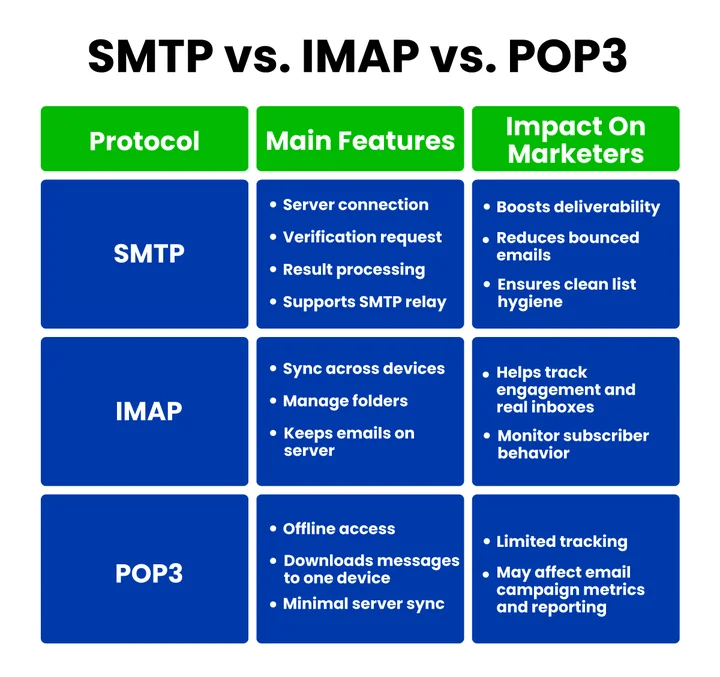
SMTP isn’t the only email protocol out there. There are two others commonly used:
- IMAP (Internet Message Access Protocol): It allows users to access and manage emails directly on the server
- POP3 (Post Office Protocol 3): It downloads messages to a device and removes them from the server.
In email marketing, these protocols have very different roles.
SMTP helps you verify if an email address can actually receive messages, which is crucial before sending campaigns. IMAP and POP3, on the other hand, are used to access or manage emails already in a mailbox.
Note: POP3 is primarily for legacy setups and personal inboxes.
How Does SMTP Check Compare To Other Email Validation Methods?
Not all email verification methods are created equal. While syntax checks or MX lookups give a quick glimpse into whether an email address might exist, they don’t confirm that your message will actually land in real inboxes.
An SMTP check, on the other hand, simulates the server-level handshake, giving marketers actionable insight into deliverability and helping refine email lists before campaigns go live.
For a clear side-by-side view, the table below breaks down the primary validation methods, showing how each fits into the SMTP-based email verification flow, their strengths, and limitations:
| Validation Type | How It Works | Role In SMTP Check Flow | Limitations |
|---|---|---|---|
| Syntax Check | Parses email format (RFC 5322) | First pre-filter | Can’t detect inactive or fake inboxes |
| MX Lookup | Identifies the mail server for the domain | Technical prerequisite | Doesn’t confirm mailbox existence |
| SMTP Check | Simulates the RCPT TO command | Confirms server-level acceptance | Catch-all and greylisting behavior |
| Deep Verification | Combines speed, SMTP check, spam trap detection, and real-time APIs through platforms like EmailVerify.io | Thorough validation may take longer to complete | Slower, privacy, and accuracy trade-offs |
How Does An SMTP Check Work?
An SMTP check is a behind-the-scenes process that ensures your business email addresses are valid and ready to receive messages. A recent research done by EmailTooltester shows that 376.4 billion emails will be sent each day in 2025.
SMTP ensures you provide a clear view of which contacts will actually land in real inboxes, helping improve deliverability and optimize your email strategy.
High-Level SMTP Check Process for Marketers
- Establish Connection: Open a connection to the recipient’s email server. Marketers just need to know this prepares the address for validation.
- Send Verification Request: Probe the email without sending an actual message to see if it’s active.
- Interpret Responses: Look for signals like success or invalid codes to decide which addresses to keep or remove.
- Act on Results: Remove invalid or risky addresses to reduce bounces, protect sender reputation, and improve deliverability.
Technical Step-by-Step SMTP Verification
- Phase 1: MX Record Lookup: Identify the recipient domain’s mail server, a prerequisite for any server-level check.
- Phase 2: TCP Connection: Open connection on ports 25, 587, or 465 and prepare for handshake.
- Phase 3: SMTP Commands: Commands like EHLO, MAIL FROM, and RCPT TO are sent. The server responds with standard codes:
- For success: 2xx
- For temporary failures: 4xx
- For permanent failures: 5xx
- Phase 4: Edge Cases & Catch-Alls: Handle catch-all servers, greylisting, and temporary failures using dual probes to ensure accuracy.
Common Pitfalls Of SMTP Checks
Even with a complete SMTP handshake, results aren’t always perfect. Some servers or configurations can make verification tricky:
- Blocked verification probes: Some mail servers refuse connection attempts for safety.
- Catch-all domains: Accept all emails, making it hard to distinguish real addresses.
- Temporary failures (4xx codes): Servers may reject checks momentarily due to anti-abuse or greylisting.
- False positives: Addresses may appear valid but still bounce later.
SMTP checks are a strong signal of deliverability, but not a 100% guarantee. Marketers should use them alongside other validation layers to protect campaigns and reduce risk.
Prepare email campaigns with verified addresses and SMTP checks
Risks Of Aggressive SMTP Probing
SMTP probing is the process of actively connecting to recipient servers to check if an email address is valid.
While this is essential for list hygiene, running too many aggressive probes can backfire and result in:
- ISP Blocks: Sending frequent verification requests may trigger anti-abuse systems and temporarily block your server.
- Greylisting Delays: Some servers temporarily reject rapid probes, which can slow down validation results.
- False Negatives: Overly aggressive checks may mark valid addresses as invalid if servers throttle or reject connections.
To avoid these issues, pace your SMTP checks, combine them with syntax and MX validation, and use verification tools that handle retries and email throttling intelligently.
Why Do Marketers Need SMTP Check?
Marketers know that every email counts. Sending to a messy list filled with invalid or stale email addresses can quietly destroy results. Bounced emails hurt deliverability, waste budget, and even harm your sender’s reputation. A reliable SMTP check lets marketers catch these issues before they escalate.
Below are the main reasons marketers can’t afford to skip it:
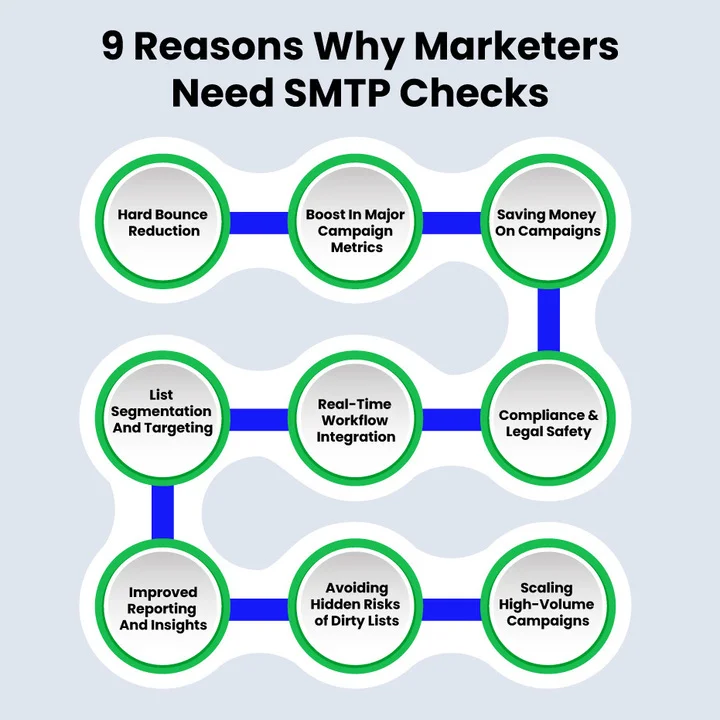
1. Hard Bounce Reduction & Sender Reputation Protection
High hard bounce rates are a red flag for email servers. Using email verifiers and running server check tests helps identify:
- Invalid addresses before sending
- Risky catch-all email accounts
- Made-up email addresses that would trigger bounce penalties
2. Boost In Major Campaign Metrics
Clean email lists improve measurable results:
- Open rates rise because messages reach active users
- Click-throughs increase as email campaigns engage real contacts
- Conversions grow when the email strategy targets verified email addresses
The table below visualizes how SMTP checks can impact campaign success:
| Metric | Without SMTP | With SMTP Check | Improvement |
|---|---|---|---|
| Bounce Rate | 0.21-10.68% | <2% | 75-90%+ drop |
| Deliverability | 85-90% | 95-98% | 9.87 |
| Open Rates | Baseline | Up to +28% | List hygiene lift |
| ROI/Sales | Baseline | 14.75 | Campaign recovery |
3. Saving Money On Campaigns
Sending to invalid email addresses costs time and money. SMTP verification reduces waste:
- Fewer per-bounce fees from ESPs
- Avoided bandwidth usage on non-existent inboxes
- Budget focuses on real inboxes that convert
4. Compliance And Legal Safety
Regulations such as GDPR and CAN-SPAM require proof of list hygiene. SMTP checks help:
- Log verification requests and server responses
- Provide audit-ready records for compliance
- Maintain reputation with ISPs and recipient servers
5. Real-Time Workflow Integration
SMTP verification can integrate directly into marketing workflows:
- Validate signups instantly via Email API/SMTP
- Clean lists before sending using SMTP-based verification tools
- Automate pre-send scrubs to protect campaigns
6. List Segmentation And Targeting
Clean subscriber lists allow more intelligent targeting:
- Separate active users from inactive contacts
- Personalize campaigns based on engagement history
- Use SMTP-based email validation to ensure segments hit real inboxes
7. Improved Reporting And Insights
Dirty email lists distort the reliability of your campaign metrics.
SMTP checks confirm which addresses are actually deliverable, giving you confidence that your data reflects real recipients.
This makes metrics such as open rates, clicks, and conversions more meaningful, helping you analyze campaigns and refine strategy with greater clarity.
8. Avoiding Hidden Risks of Dirty Lists
SMTP authentication uncovers hidden dangers:
- catch-all email and role-based addresses
- Legacy spam traps
- Risky domains that trigger ISP penalties
Marketers can act before a small mistake damages deliverability.
9. Scaling High-Volume Campaigns
For large campaigns, automation is crucial. Marketers go for:
- Batch server connection checks
- Hybrid verification combining SMTP integration with syntax and MX checks
How Can Marketers Apply SMTP Checks Before Things Go Wrong?
By now, you understand what an SMTP check is and why it’s necessary. The real win, though, comes from using it before problems show up in reports or inbox placement tanks.
If you skip SMTP checks, this can also happen to you:
A SaaS marketing team sends their monthly newsletter to 8,000 newly imported leads without verifying the emails. Within hours, 1,200 emails bounce, mainly from inactive company addresses and mistyped domains. Their next campaign suffers lower inbox placement and open rates as repeated bounces hurt sender reputation.
The practices we’re going to discuss will keep campaigns predictable, protect performance, and help you stay ahead of bounces.
Let’s break down how marketers actually use SMTP checks in day-to-day workflows.
Pre-Send List Hygiene
This is where most deliverability issues either start or stop.
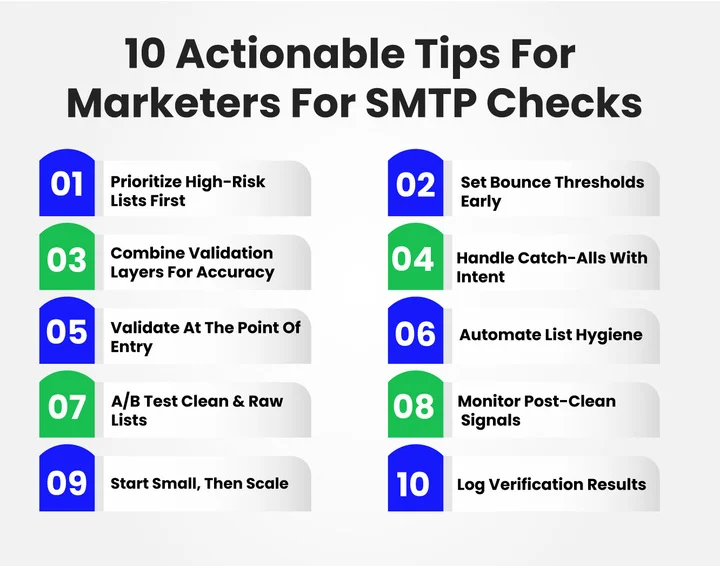
1. Prioritize High-Risk Lists First
Purchased, scraped, or cold lists almost always carry risk. It’s common to see 5 to 15 percent of addresses invalid here, compared to 1 to 2 percent for organic signups.
Running an SMTP check weekly on these lists helps you spot problems before they turn into spam complaints or blocked sends.
2. Set Bounce Thresholds Early
Before you launch a campaign, define clear limits. If more than 3 percent of addresses fail validation, suppress them.
Most ESPs expect bounce rates under 2 percent. Staying below that line helps protect the sender’s reputation and keeps your email server trusted.
3. Combine Validation Layers For Accuracy
Relying on one method is risky. Syntax checks catch formatting issues. MX checks confirm the recipient domain.
An SMTP check verifies server acceptance. Together, they deliver better accuracy without wasting resources on deep checks for low-value lists.
4. Handle Catch-Alls With Intent
Catch-all domains often return a positive result even for a made-up email address. Smart email verifiers use dual probes to flag these. Treat them as risky, segment them separately, and test engagement before rolling them into complete sends.
Real-Time & Signup Integration
Clean lists are easier to maintain than to fix.
5. Validate At The Point Of Entry
Adding SMTP-based email verification to signup forms prevents insufficient data from reaching your subscriber list. Real-time checks reduce fake signups, bots, and typos without hurting conversions.
6. Automate List Hygiene
Tools like HubSpot or Zapier can trigger nightly checks on new leads. This removes manual work and limits exposure to bounced emails. Over time, automation alone can save hours and reduce human error.
Campaign Performance & Testing
SMTP checks are not just defensive. They are measurable growth levers.
7. A/B Test Clean & Raw Lists
Split a campaign evenly. One segment runs on a clean list. The other doesn’t. Track opens, clicks, and bounces. Most marketers see higher engagement and clearer insights when invalid addresses are removed.
8. Monitor Post-Clean Signals
After validation, watch sender scores and inbox placement. A steady drop in spam analysis warnings or bounce alerts often ties directly to consistent SMTP check usage.
Budget & ROI Management
Deliverability mistakes cost more than tools ever will.
9. Start Small, Then Scale
Many tools offer limited free checks. Use them to validate high-risk segments first. As volume grows, paid plans often cost a fraction of what failed sends waste. This is one of the fastest ways to save time and resources.
Compliance & Documentation
Clean data is also a legal safeguard.
10. Log Verification Results
Storing server response codes such as 250 or 550 provides proof of intent. If compliance questions arise under GDPR or CAN-SPAM, these logs show you took steps to reach only legitimate recipients and avoid abuse.
Conclusion: Are Your Emails Really Reaching the Inbox?
If you’ve ever wondered why some campaigns flop despite strong content, it often comes down to deliverability.
A well-executed SMTP check ensures that your email communication reaches its intended recipients while protecting your business email addresses and maintaining a healthy sender reputation.
Competence in SMTP email verification, from understanding server connections and verification requests to interpreting server responses and managing invalid addresses, alters how your email campaigns perform.
After reading this guide, here’s what you should do next:
- Audit your email lists for high-risk or outdated contacts.
- Layer validations: syntax, MX, and SMTP verification.
- Track and analyze post-clean metrics for active users and engagement.
- Integrate real-time checks at signups to keep the campaign clean.
- Schedule regular server check tests to maintain consistent deliverability.
Frequently Asked Questions (FAQs)
2. How Do Catch-All Domains Impact My Email Strategy?
Catch-all email domains accept all emails regardless of validity. While they may show a positive server response, engagement can be low. Segmenting them separately allows marketers to target active users effectively without risking spam complaints.
3. Are SMTP Checks Compatible With Marketing Automation Tools?
Absolutely. SMTP integration can be layered into platforms like HubSpot or Mailchimp or via Email API/SMTP. This ensures lists are validated in real-time and keeps campaigns running smoothly without manual cleanup.
4. Can SMTP Verification Reduce Resource Usage?
Yes. By catching invalid addresses early with tools like EmailVerify.io’s bulk email verification, SMTP checks reduce wasted bandwidth, server load, and ESP credits. This saves time and resources while keeping your SMTP infrastructure efficient.
5. How Do Temporary Server Failures Affect SMTP Checks?
Sometimes a recipient server returns a 4xx code, indicating a temporary failure. Advanced email verifiers can retry later, ensuring accuracy without prematurely marking legitimate email addresses as invalid.
6. Do SMTP Checks Help With Enterprise Email Deliverability?
Yes. For large-scale campaigns, SMTP verification for enterprise email ensures high deliverability, avoids bounced emails, and protects reputation across multiple recipient servers simultaneously.
7. How Can Developers Use SMTP Checks in Their Applications?
With an email validation API, SMTP checks can be added directly to forms, apps, and internal workflows to stop bad data at the source. Using EmailVerify.io’s email verification API, developers can:
- Validate emails at signup
- Block mistyped or unreachable addresses
- Keep user databases clean over time
- Send verified contacts to CRM tools
- Check emails during internal QA or support
This approach keeps validation practical, early, and invisible to end users, which is exactly where it works best.
Want to Protect Your Sender Reputation?


